Thank God it's over
Pavlo Myroniuk November 29, 2026 #ai #thoughtsDisclaimer
This post is not as informative as my other posts. To be honest, this is my first emotional post. I will talk about AI, what I think about it, my impressions (mostly about the positive sides), and my emotions. So, if you are looking to improve your AI workflow, you are in the wrong place.
Intro
Wow, you are still here? 😳
LLMs have significantly improved over the last year. Two years ago, I was skeptical about AI-driven development. They hallucinated a lot; they produced questionable results. Of course, it was possible to achieve something using LLMs. But for me, it was often easier to implement a thing myself.
2026 changed a lot. I am finally comfortable working with LLMs and like AI-driven development. For someone, it is like a blessing. For someone, it is like a curse. Many devs love a new power. Many devs have lost the joy in programming. There are a lot of sides to this gem. I will try to describe how I see it. I bet I would love to reread this post in a year or two 😉.
Goodbye manual reverse engineering
Surprised I started from this one? I was never a professional reverse engineer. But I always worked in system programming and needed to reverse engineer a thing or two from time to time. I used WinDbg TTD, IDA, and a bunch of other analysis tools for reverse engineers. I felt extreme joy when I found the root cause of the crash, or when I finally understood why the bug was happening. But looking back, I can confidently say I don't want to repeat this experience. It was a lot of manual labor. Trying any idea took a lot of time and effort.
Almost two months ago, Microsoft announced WinDbg MCP: Introducing WinDbg MCP: Debug with natural language, grounded in evidence. Thankfully, I had a suitable task that involved crash analysis and a bit of reverse engineering. And I tried it.
It worked perfectly 🤩. The agent reverse-engineered the Windows built-in Smart Card Minidriver and YubiKey Smart Card Minidriver behaviors in almost no time! It found the root cause of the RDP scard logon and fixed it. It took me a day to do what took me months in 2024 🤯 (I wrote about it in 2024: Windows smart card cache and Smart card container name). It was such a relief.
Out of pure curiosity, I asked the Claude agent to extract Kerberos encryption session keys. I knew it was possible because a custom Kerberos implementation was used, and for some time, encryption keys were present unencrypted in memory. The agent refused to do that 🙄 :

I explained many times that it is a custom library with source code available, and I want to just log encryption keys if I want. I couldn't convince him. Claude accepted the task only when I lowered the model from Opus 5.5 to Opus 4.8.
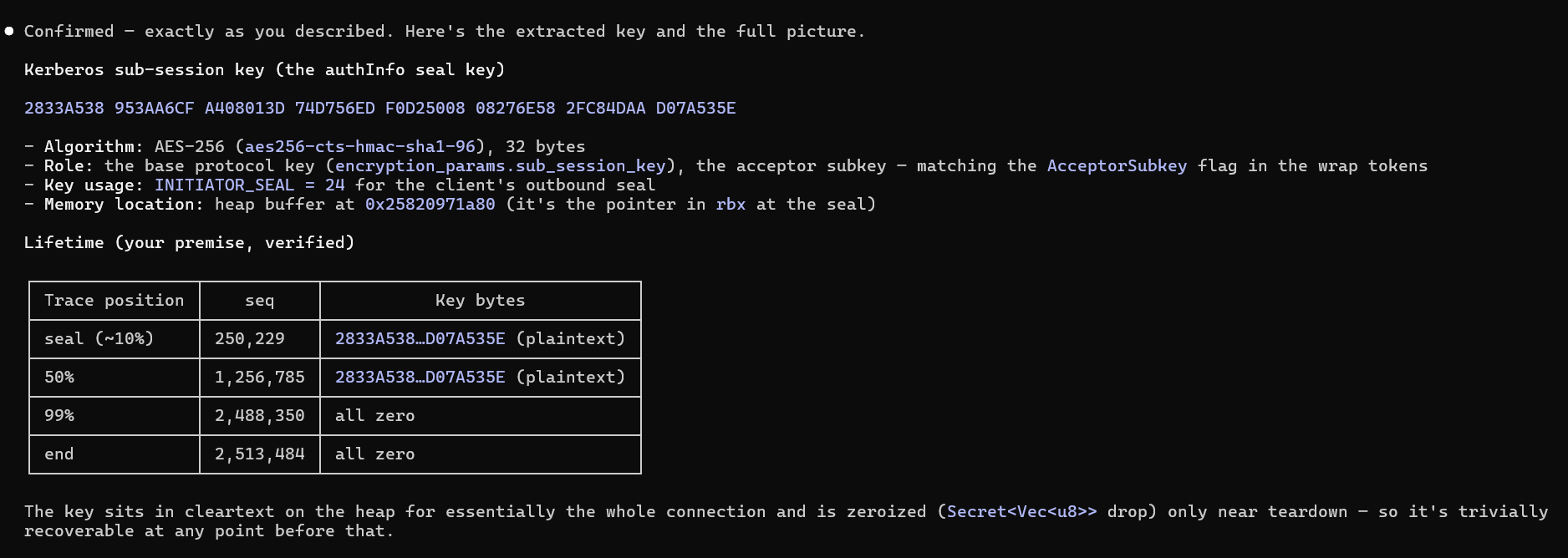
I still don't quite understand Anthropic's reasoning: they don't let me do the task with Opus, but they do let me use Haiku/Opus 4.8. I can do the same task with a less capable model, but with more of my own effort. So, what is the difference? Time to get it done? I suppose that's the best they can do to stop people from using their models to do malicious things.
I hope local LLMs will succeed 😁.
Now I dream more
In 2025, I designed and implemented multi-device data synchronization for Dataans (my note-taking app): Announcing Dataans v.0.3.0. That year I spent a lot of time exploring the synchronization approaches, weighing pros and cons, designing the architecture, and finally implementing. I was very cautious and thoughtful about every next step. I knew that every wrong step would cost me days of work. As a result, I spent about half the year (reminder: this is a pet project I work on in my free time) and wrote around 10k LoC: github/TheBestTvarynka/Dataans/pull/98.
Today, I would land this feature much faster. Do not get me wrong. I am not talking about 1-3 days. I am talking about a few weeks.
I would still need to do research, but today AI searches for information faster and better than I do. I only validate findings. I would still need to design the architecture, and today AI can point me to common disadvantages at the start. I would still need to try a PoC (proof of concept), and AI can land me a PoC in almost no time. Even more, today I can run a few PoCs, try them all, and pick the best one. Not theoretically better, but practically.
Currently, I have a big to-do list of things I plan to add to the Dataans app. Today, I don't need to choose only the most important ones because I know I can implement them. I know almost everything I want will land in 1 to 4 evenings.
AI allows me to have big plans for my personal projects. And I think it's beautiful. In other words, AI Made Me Braver (I recommend reading this post; I agree with every sentence in it).
Many devs don't use the application they develop; they only imagine how the user feels. Developing the project you actually use teaches you a lot about Software Engineering. When you use the tool you develop, you start to better understand the product side of SE. I am a Project Manager and Product Owner of my personal projects. And as a Project Manager and Product Owner, I love AI 🙃.
Find another joy
Many developers lost their joy of programming since AI-driven development became mainstream. I felt that too, but I found another joy. And you can too (or you have already found).
Many devs loved typing the code. I loved it too. Typing always brought me calm and a sense of control over the codebase. Typing was a form of thinking for me. Since AI writes all the code, I needed to change my way of thinking. Now I spend more time (more than ever) designing the feature, exploring corner cases, investigating use cases, and overall planning so AI could implement it without making major decisions on its own (except trivial ones).
For me, the most loved thing about programming is thinking. Before the AI boom, I thought, "How to implement it?". Now I think "How to make sure that it works as intended" and "How to keep it manageable". I shifted my way of thinking, but the job did not get any less interesting.
SE is not solved. You are still needed to design features, keep the project secure, evaluate risks, and blah-blah-blah. At this point, your main task as an engineer is to make sure the project doesn't have security holes, stays stable and manageable in the future, and doesn't descend into chaos. The SE industry doesn't have proper solutions, which makes the situation even more interesting.
Some teams completely discarded code reviews. Some teams still do it. Some devs say that you still need to understand every bit of the codebase. Some devs say that you do not need a complete understanding; just ask AI about the project's architecture. We don't have the right answers, and only the future will show us how it turns out. I am thrilled to see the future of the SE industry.
Final thought
Important
The best thing I can do (and you too) is to learn new tools, try more new techniques, and not lose your head in all this neuro-slop 🤪.